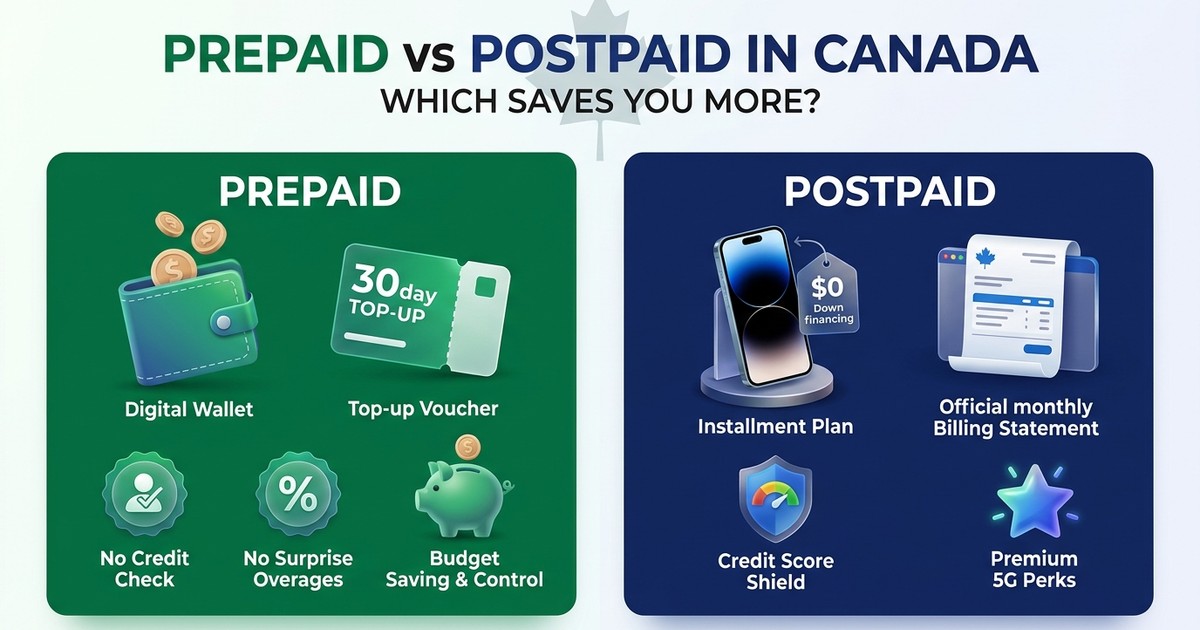
If you already own your phone, choose prepaid: it’s usually cheaper, needs no credit check and has no contract. Choose postpaid only if you want to finance a phone through your carrier or need a specific Big Three perk.
The line between the two has blurred. Both types now offer unlimited Canada-wide talk and text, 5G on some tiers, and no contract on bring-your-own-phone plans. What still separates them is who checks your credit, whether a carrier can lend you a phone, and how you pay.
The short version
| Prepaid | Postpaid | |
|---|---|---|
| How you pay | Up front, before the month starts (usually by card, often auto-renewing) | Monthly bill, after you’ve used the service |
| Credit check | Not required | Expected for new customers |
| Finance a phone through the carrier | No | Yes |
| Contract | None | None on bring-your-own-phone; a device payment plan is a separate obligation |
| Typical carriers | Public Mobile, Lucky Mobile, chatr | Bell, Rogers, Telus, Koodo, Fido, Virgin Plus |
Not every carrier fits neatly into one column. Before you sign, check how a plan bills and whether it runs a credit check.
What it costs: prepaid vs postpaid, side by side
These are bring-your-own-phone prices for a single line, from our tracked data, verified November 1, 2026:
| Plan | Type | Price/month | Data |
|---|---|---|---|
| Lucky Mobile 5GB | Prepaid | $25/mo† | 5GB (4GB base + 1GB with Automatic Top-Up), 4G |
| chatr 15GB | Prepaid | $30/mo† | 15GB (10GB base + 5GB with auto-pay), 4G |
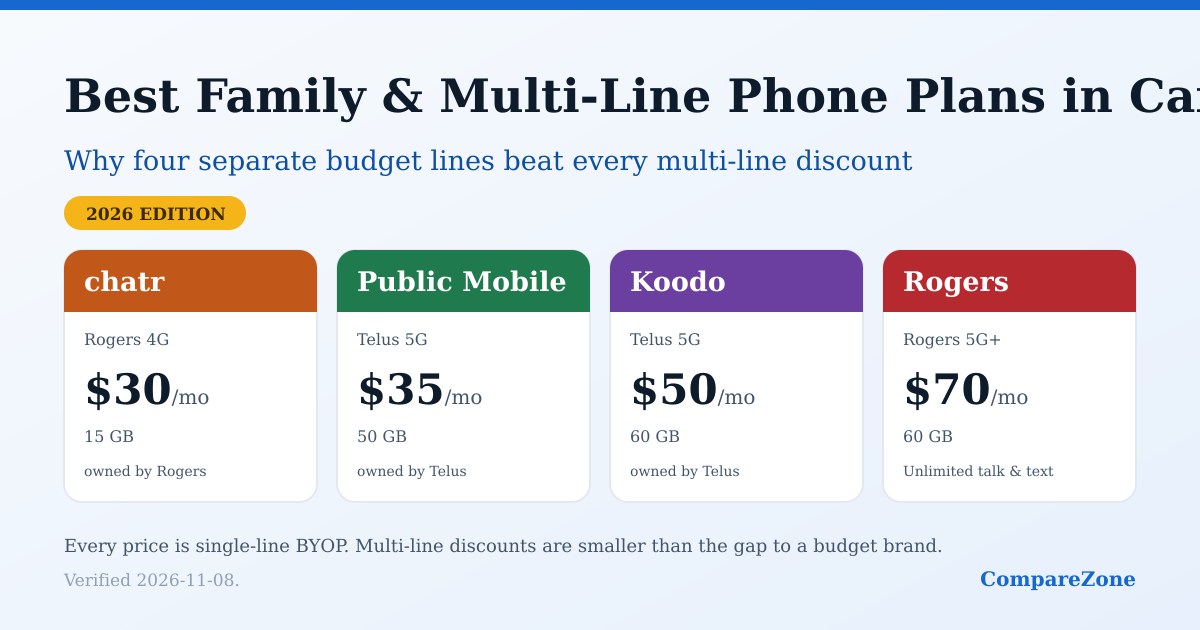
| Public Mobile 35GB | Prepaid | $30/mo | 35GB, 4G |
| Public Mobile 50GB | Prepaid | $35/mo | 50GB, 5G |
| Koodo 10GB | Postpaid | $40/mo† | 10GB, 5G |
| Fido 20GB | Postpaid | $45/mo† | 20GB, 5G |
| Bell / Rogers / Telus 60GB | Postpaid | $70/mo† each | 60GB, 5G+ |
Two honest caveats before you conclude prepaid always wins:
- Postpaid prices are usually “after credits.” Koodo’s $40/mo† already includes $10/month of discounts, one of which needs pre-authorized bank payments. Fido’s $45/mo† assumes a $5/month Auto-Pay credit. Bell, Rogers and Telus all advertise a lower price still, but only with home internet or TV (or, at Telus, home security) on the same account. If you don’t meet the conditions, you pay more.
- Prepaid data often includes a bonus for enrolling in auto top-up or auto-pay (Lucky and chatr, above), and it’s for new activations only.
The gap is real but not fixed. Comparing the same data tier, prepaid Public Mobile at 35GB costs less than a Koodo plan with a third of the data. Bell, Rogers and Telus charge $70/mo† for 60GB, roughly double Public Mobile’s 35GB or 50GB plan, for what the Big Three call premium networks and perks.
| Carrier | Data | Network | Price |
|---|---|---|---|
| no name mobileon Bell | 2 GB | Bell 4G | $19/mo |
| PC Mobileon Bell | 1 GB | Bell 4G | $19/moAuto-pay required |
| Public Mobileon Telus | 1 GB | Telus 4G | $22/mo |
| SpeakOut Wirelesson Rogers | 0.5 GB | Rogers 4G | $22/mo |
| chatron Rogers | 0.5 GB | Rogers 4G | $22/moAuto-pay required · New customers only |
| Lucky Mobileon Bell | 0.5 GB | Bell 4G | $22/moAuto-pay required · New customers only |
| Public Mobileon Telus | 5 GB | Telus 4G | $24/mo |
| no name mobileon Bell | 6 GB | Bell 4G | $25/mo |
| PC Mobileon Bell | 5 GB | Bell 5G | $25/moAuto-pay required |
| SpeakOut Wirelesson Rogers | 5 GB | Rogers 4G | $25/mo |
Credit checks: the biggest practical difference
Prepaid: none. You’re paying before you use the service, so the carrier has nothing to lend you and nothing to check. That’s why prepaid is the default recommendation for students and newcomers who have no Canadian credit history.
Postpaid: expect one. Koodo says it plainly in its fine print: “A credit check is required for all new postpaid customers.” Treat a credit check as the norm at the other postpaid carriers too, and confirm on the carrier’s page.
If your credit is thin or damaged, a postpaid carrier may ask for a security deposit or limit what you can finance. Ask what the deposit would be, and when you get it back, before you sign.
A credit check is a “hard inquiry” that can appear on your Canadian credit file. It’s a minor factor for most people, but if you’re about to apply for a mortgage or car loan, it’s one more reason to avoid unnecessary applications.
Financing a phone: the case for postpaid
This is the one situation where postpaid genuinely does something prepaid can’t. Bell, Rogers, Telus and their flankers will spread the cost of a new phone over your bill.
The catch is what happens when you leave:
- A phone with a subsidy or payment plan still ties you to the carrier. Since June 12, 2026, the CRTC has banned early cancellation fees on wireless plans without a subsidized device, but the carrier can still charge for the remaining device balance (CRTC 2026-43; see our explainer). That’s the practical lock-in now.
- Bell and Rogers add a $40 device fee. Bell charges it on every new or upgraded phone, online included. Rogers waives it when you order the phone yourself online, but then charges $25 to ship it (details).
- You pay more per month for the same data. A financed phone on a $70/mo† Big Three plan costs far more over 24 to 36 months than a $30/mo prepaid plan plus a phone bought outright, unless the carrier is running a real promotion.
Buying the phone separately (from the manufacturer, a retailer, or used) and pairing it with a cheap plan is often the better financial move. If you can’t pay for a phone up front, a financed phone on a postpaid plan is the trade-off you’re making, and that’s fine as long as you know the total cost.
Prepaid: pros and cons
Pros
- Cheapest way to get a lot of data in Canada.
- No credit check, no contract, no surprise overage bill.
- Easy to leave: switching costs nothing on a no-subsidy plan.
Cons
- No carrier phone financing.
- Mostly digital-only support (Public Mobile, for example, has no stores).
- Lower tiers are 4G only, and some carriers hold 5G for higher-priced plans.
- Fewer bundle discounts and perks than the Big Three.
Postpaid: pros and cons
Pros
- Phone financing, and access to carrier trade-in deals.
- Physical stores and phone support at most carriers.
- Bundle discounts if you also buy home internet or TV from the same company.
Cons
- Credit check, and possible deposit.
- Prices depend on credits you have to keep qualifying for.
- A financed phone makes leaving expensive.
How to save money whichever you pick
- Own your phone outright if you can. Both plan types are cheapest on bring-your-own-phone.
- Check whether the price is before or after credits. Read the fine print on autopay and bundle requirements.
- Postpaid customers can still negotiate. See how to lower your phone bill, including which flanker to threaten to switch to.
- Try prepaid without commitment. With no fee to switch, you can test Public Mobile, Lucky or chatr for a month or two. If you have eSIM, activation takes minutes.
- Compare the flankers directly: Public Mobile vs Fizz, chatr vs Lucky vs Public Mobile, Fido vs Koodo vs Virgin Plus.
FAQ
Is prepaid the same network as postpaid? Often, yes. Public Mobile and Koodo run on Telus, chatr and Fido on Rogers, Lucky Mobile and Virgin Plus on Bell. The differences are usually speed tiers (prepaid low tiers are 4G) and support, not coverage.
Does prepaid have a contract? No. You pay up front and can leave any month.
Will a postpaid plan hurt my credit score? Applying triggers a credit check. Paying on time can help your file; missed payments will hurt it. The plan itself isn’t a loan unless you finance a phone.
Can I get a new phone on prepaid? Not financed through the carrier. You can buy a phone from a retailer and use it with any prepaid SIM.
Can I switch from postpaid to prepaid? Yes, and with no cancellation fee on a no-subsidy plan since June 12, 2026. If you have an unpaid device balance, you’ll still owe it.
Our recommendation
If you own a phone or can buy one: prepaid, starting with Public Mobile at $30/mo for 35GB. If you need financing or a store to walk into: postpaid, but check the price with and without credits, and run the total two-year cost against buying the phone yourself.
Last verified: September 29, 2026. Plan prices come from our tracked dataset, verified November 1, 2026, and can change without notice. Always confirm on the carrier’s site before signing up.
CompareZone may earn a commission if you sign up through some of the links on this page. It never changes the price you pay, and it never decides what we recommend. Every plan here is ranked on the numbers above.
Ready to stop overpaying?
Compare every current plan, or check in 30 seconds if you're overpaying.